|
This channel is intended for people just starting with the Raku Programming Language (raku.org). Logs are available at irclogs.raku.org/raku-beginner/live.html Set by lizmat on 8 June 2022. |
|||
|
03:23
kjp left
03:24
kjp joined
05:22
SabeDoesThings joined,
SabeDoesThings left
13:06
librasteve_ joined
|
|||
| disbot2 | <librasteve> here's a beginnery question... | 13:10 | |
| <librasteve> m: my $i = 2**128; say $i**2; | 13:11 | ||
| <Raku eval> 115792089237316195423570985008687907853269984665640564039457584007913129639936 | |||
| <librasteve> here Int is showing it's arbitrary precision chops - nice | |||
| <librasteve> m: my $i = 2**128; say $i**$i; | |||
| <Raku eval> Exit code: 1 Numeric overflow in block <unit> at main.raku line 1 | |||
| <librasteve> here Int does Numeric overflow ... wtf - it's supposed to be arbitrary precision ... well OK I guess I made a BIG Int there - so does anyone know the situation(s) when Int will overflow? | 13:13 | ||
| <antononcube> Those numbers are too big. | 13:16 | ||
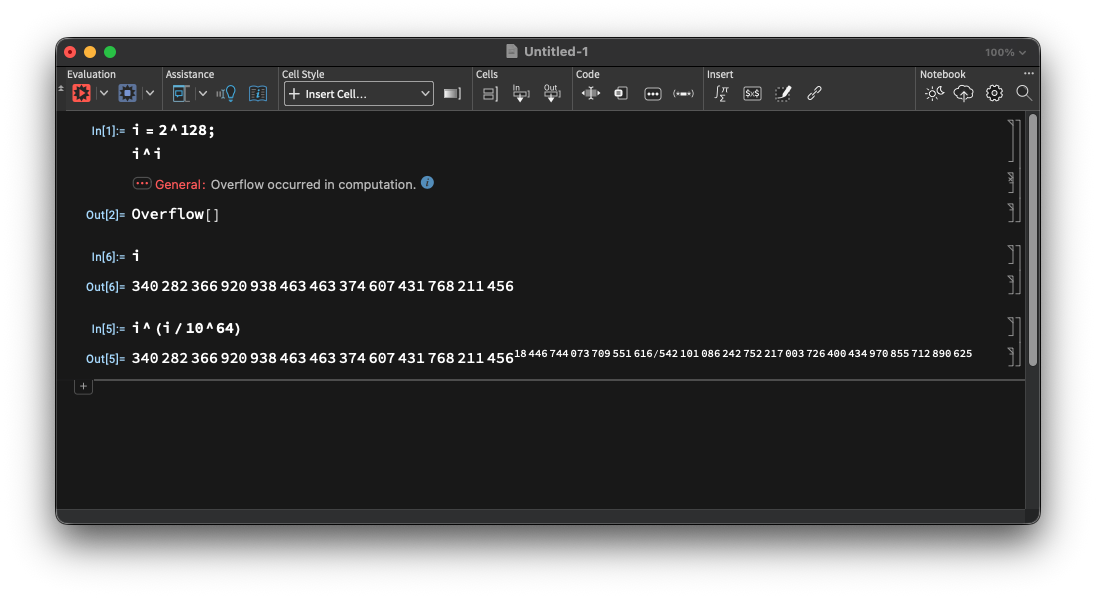
| <antononcube> If it makes you feel better Mathematica gives "Overflow" too. | 13:17 | ||
| <antononcube> One can experiment with incrementally decreasing the exponent and see is a result obtained: | 13:18 | ||
| <antononcube> cdn.discordapp.com/attachments/768...857a0& | |||
| <antononcube> The second result here is kind of problematic too: my $i = 2**128; $i .= FatRat; say $i**$i; # Inf say $i**($i / (10**64)) # 1 | 13:20 | ||
| <librasteve> Those numbers are too big (no shit sherlock) | 13:21 | ||
| <librasteve> If it makes you feel better Mathematica gives "Overflow" too. yes - much better, thanks! | |||
| <librasteve> last one looks like a bug to me | 13:22 | ||
| <librasteve> oh wait, engages brain | |||
| <librasteve> I am cool if FatRat behaves predictably (like x**0 == 1)in these extremes (I would set non-linear operations like fractional roots outside the reasonable expectation of always works) ... room for improvement in the implementation perhaps | 13:25 | ||
| <antononcube> Note, that Mathematica did not compute i ^ (i/10^64) -- just kept it unevaluated. | 13:28 | ||
| <antononcube> This the reason I am saying the numbers too big -- not just in "conventional" sense, but in BigNum sense. | |||
|
13:28
Guest75 joined
|
|||
| disbot2 | <librasteve> maybe in the "ran out of RAM sense" | 13:29 | |
| lizmat | .oO( not enough bytes in the universe ) |
||
| disbot2 | <librasteve> I am just wondering what the limiting constraint is | ||
| <antononcube> Or limitations of the representations of the numbers. E.g. max string length, or something similar. | 13:30 | ||
| <antononcube> Right, one way to do that is to observer results with consequiteve decreases (or increases) of the exponent. | 13:31 | ||
| <librasteve> =b | 13:33 | ||
|
13:33
sibl joined
15:32
sibl left
15:36
sibl joined
15:40
sibl left
16:56
Guest75 left
|
|||